 By
You sign up for a weekly yoga class with the best intentions. Perhaps your lower back feels permanently stiff from eight hours a day in an office chair, your shoulders are creeping toward your ears from stress, or you simply want to balance out your running or lifting routine with some restorative stretching. The marketing around modern yoga promises a sanctuary of low-impact healing, mindfulness, and gentle joint decompression.
Yet three or four weeks into your new journey, reality looks decidedly unzen. Your wrists throb whenever you push yourself up from a table. A sharp, burning ache has settled directly beneath the crease of your glutes. Your lower back feels more compressed than it did before you bought your mat, and your shoulders click every time you reach overhead.
The immediate reaction is often self-blame. You assume your body is fundamentally flawed, hopelessly tight, or simply not built for yoga.
The truth is far more pragmatic: yoga is not inherently gentle, and it is rarely low-impact for an unconditioned body. When stripped of its spiritual branding, a modern dynamic yoga class is an athletic regimen of bodyweight gymnastics, high-volume end-range loading, and sustained isometric contractions. When beginners jump onto the mat without understanding the mechanical demands of the practice, injury is not an anomaly; it is an almost predictable physiological outcome.
The “Gentle Stretch” Myth: Underestimating the Mechanical Demands
The primary reason novice practitioners get hurt is a fundamental misunderstanding of what a yoga class actually demands from human musculoskeletal tissue. Because yoga is categorized under wellness rather than strength sports, beginners treat a dynamic sixty-minute flow with the same casual attitude they would bring to a light neighborhood stroll.
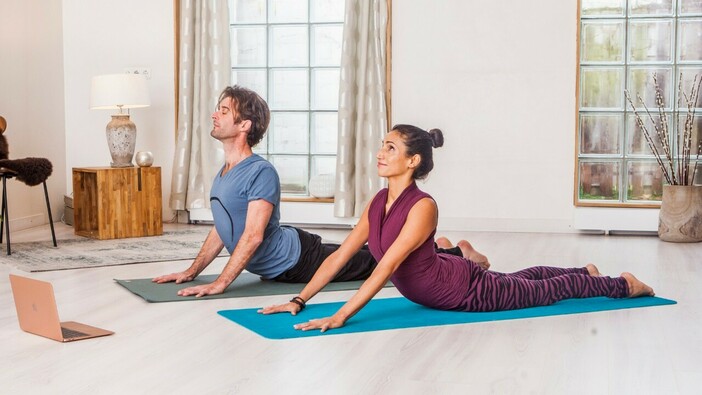
In a standard Vinyasa or Power Yoga class, you are repeatedly moving your entire body mass against gravity through extreme ranges of motion. A single class might require you to lower your body into a half-push-up (Chaturanga Dandasana), press upward into an intense lumbar backbend (Upward-Facing Dog), and kick back into a weight-bearing shoulder flexion hold (Downward-Facing Dog) thirty to fifty times.
For an individual who rarely does push-ups or spends most of their day sedentary, this sudden spike in repetitive eccentric loading is a shock to the system. Muscles, tendons, and connective tissues require progressive adaptation to handle heavy loads. Plunging into dozens of complex bodyweight presses within an hour without establishing baseline tissue tolerance sets the stage for acute strains and overuse tendinopathy.
Passive Flexibility vs. Active Mobility: The Ligament Trap
Most people arrive on the mat believing the ultimate goal of yoga is flexibility: the ability to passively stretch a muscle into a lengthened state. However, flexibility without muscular control is a structural liability.
Joint health relies on active mobility, which is your ability to actively control, stabilize, and produce strength throughout a full range of motion. When you lack the active muscular strength to hold an extreme position, your body has only one alternative way to stop you from collapsing: hanging on your passive restraints. These passive restraints include your joint capsules, ligaments, labrums, and tendons.
This dynamic creates two distinct categories of injured beginners:
-
The Stiff Practitioner: These individuals enter yoga with restricted range of motion, usually through the hips, ankles, and thoracic spine. Instead of accepting their current mechanical limits, they use momentum, gravity, or external leverage to force their bodies into the shapes they see across the room. Because their stiff joints refuse to yield, the force bypasses those structures and shears straight into vulnerable transition zones, such as the lumbar spine or sacroiliac joints.
-
The Hypermobile Practitioner: These individuals are naturally bendy and can easily slide into deep splits, backbends, and hip openers on day one. Because they encounter no muscular resistance, they receive praise for being natural yogis. However, because they lack the deep stabilizing strength to control those extreme angles, they continuously dump their entire body weight directly into their hip labrums, knee ligaments, and spinal facet joints. Over time, this passive hanging degrades joint integrity and triggers severe, chronic instability.
Anatomical Hotspots: Where Beginners Break Down
While yoga moves every joint in the body, beginner injuries concentrate in predictable anatomical zones where modern lifestyles collide directly with traditional posture mechanics.
The Wrists and Forearms
In standard day-to-day life, the human wrist rarely experiences full ninety-degree extension under load. Yet the moment you step onto a yoga mat, you place the majority of your body weight directly onto your hands in Downward Dog, Plank, and Arm Balances.
Beginners almost universally make the mistake of dumping their weight into the heel of the palm, near the carpal tunnel and the delicate triangular fibrocartilage complex (TFCC) on the pinky side of the wrist. Without active hand engagement, the wrist joint is mechanically compressed.
To protect the joint, the hand must act like a supportive foot. You must activate the hastha bandha—an active grip where the knuckles of the index finger and thumb press firmly into the rubber mat, the fingers spread wide, and the fingertips cup the ground slightly. This muscular activation redistributes compressive forces away from the wrist crease and recruits the stabilizing flexors and extensors of the forearm.
The Sacroiliac Joint and Lower Back
The junction between your sacrum and the iliac bones of your pelvis—the sacroiliac (SI) joint—is built for stability and shock absorption, not large-scale movement. It is held together by some of the strongest, densest ligament networks in the human body.
Many classic yoga postures, such as Warrior I, Triangle, and Revolved Crescent Lunge, demand substantial pelvic asymmetry. For example, in a traditional stance, the front leg is flexed while the back leg is internally or externally rotated and extended. Instructors frequently cue students to “square your hips to the front of the room.”
If a student has tight hip flexors or restricted hip internal rotation, the pelvis cannot physically rotate forward on its own. To fulfill the verbal cue, the student forcefully twists through their pelvis, torqueing the sacrum against the ilium. Repeating this twisting shearing force under body weight loosens the stabilizing ligaments of the SI joint, resulting in a persistent, sharp pain deep in the rear pelvis that radiates into the lower back or down the buttock.
The Proximal Hamstring: “Yoga Butt”
One of the most notorious injuries in the yoga community is proximal hamstring tendinopathy, colloquially dubbed “yoga butt.” It presents as a deep, nagging ache directly at the ischial tuberosity, the bony sit bone at the base of your pelvis.
The hamstrings originate at this bony anchor point. Dynamic yoga classes feature endless straight-leg forward folds: seated forward bends, standing forward folds, wide-legged forward bends, and downward dogs. When a practitioner hinges forward with completely straight knees, the hamstring tendon is pulled across the ischial tuberosity like a rope over a sharp rock, subjected to immense tensile and compressive stress.
Performing dozens of passive forward folds per class prevents the irritated tendon from resting or remodeling. Without eccentric strength training to rebuild the tendon’s load capacity, the chronic micro-trauma turns into a stubborn, degenerative condition that can take months or years to resolve.
The Shoulders and Scapular Winging
The shoulder is the most mobile joint in the human body, relying almost entirely on muscular co-contraction from the rotator cuff and scapular stabilizers for its structural integrity.
In a fast-paced class, students are repeatedly asked to lower down from a high plank into a low hover (Chaturanga). When core or tricep strength fatigues, the elbows inevitably flare wide, the shoulder heads dip forward and down toward the floor, and the shoulder blades wing off the ribcage.
This mechanical breakdown places the biceps tendon and the supraspinatus tendon of the rotator cuff in direct conflict with the acromion process, causing acute shoulder impingement. Repeating this collapse twenty to thirty times per session grinds down the shoulder stabilizers and turns an energizing practice into a source of chronic joint inflammation.
The Perils of Visual Mimicry and the Ego Trap
Unlike weightlifting, where progress is quantified through sets, reps, and pounds on a bar, yoga progress is frequently evaluated through visual aesthetics. Students look around the room or scroll through curated social media feeds and assume that performing a posture correctly means creating a visual replica of an advanced practitioner’s shape.
This visual mimicry ignores the massive role of skeletal architecture. Human bones are uniquely shaped:
-
The depth and angle of your hip sockets (acetabular orientation) dictate how far your femur can move before bone meets bone.
-
The torsion of your femoral neck determines whether your hips naturally favor internal or external rotation.
-
The carrying angle of your elbows influences how your arms stack when bearing weight.
When you attempt to force your limbs to mimic someone else’s external geometry, you frequently push past your anatomical limits, grinding soft tissue between bony structures.
This problem is compounded by class pacing. In dynamic flow classes, instructors often move students through complex transitions to the beat of an upbeat playlist. When movement speed outpaces muscular control, neuromuscular stability vanishes, and the likelihood of acute joint sprains multiplies.
How to Build a Resilient, Injury-Free Yoga Practice
Transforming yoga from a source of injury into a sustainable vehicle for longevity requires stepping back, shedding ego, and applying intelligent strength and conditioning principles to your time on the mat.
Micro-Bend Your Knees to Protect Tendons
If you implement only one mechanical change to your practice, make it this: never lock your knees during forward folds.
Maintaining a soft, active micro-bend in your knees during standing and seated forward bends shortens the lever arm on your hamstrings. This takes aggressive passive tensile stress off the proximal hamstring tendon at the sit bone and transfers the stretch into the thick, vascular muscle belly where it belongs. Bending your knees also allows your pelvis to rotate forward over the femurs freely, sparing your lumbar spine from excessive compensatory rounding.
Treat Props as Essential Structural Tools
There is a pervasive, unspoken stigma among beginners that utilizing yoga blocks, straps, and bolsters represents a failure of flexibility. In reality, props are performance tools that optimize joint biomechanics.
Placing a pair of high-density foam or cork blocks underneath your hands in a forward fold or lunge elevates the floor by six to nine inches. This subtle elevation allows an individual with tight hips or a stiff spine to maintain a neutral, supported back rather than hanging from their lower lumbar vertebrae.
Similarly, looping a strap around your foot in a seated stretch allows your shoulders to remain packed and relaxed, eliminating the rounded, hunched posture that strains the upper back and neck.
Modify Chaturanga Ruthlessly
Chaturanga is an advanced gymnastic movement, not a basic baseline posture. If you cannot perform five strict, controlled military push-ups with perfect form, you have no business doing full-bodyweight Chaturangas in the middle of a sixty-minute class.
Check your ego and modify the movement:
-
Lower your knees to the mat during every transition from high plank to low plank. This instantly unloads half your body mass, allowing your core to stay engaged and preventing your lower back from sagging.
-
Stop lowering when your elbows reach a ninety-degree angle. Never allow your shoulder heads to dip lower than your elbows.
-
Skip the transition entirely when muscular fatigue sets in. Pushing back directly into Downward-Facing Dog or resting in Child’s Pose demonstrates advanced somatic intelligence, not weakness.
Cross-Train with Pulling and Loaded Resistance
Yoga is an exceptional discipline for developing pushing strength, balance, and spatial awareness. However, it possesses a massive, glaring biomechanical blind spot: yoga contains virtually zero horizontal or vertical pulling movements.
Because a standard practice is heavily biased toward anterior pushing and overhead pressing, practitioners easily develop structural imbalances. The chest and front deltoids become overactive, while the posterior chain—specifically the latissimus dorsi, rhomboids, rear deltoids, and middle trapezius—remains understimulated.
To make your body resilient on the mat, you must cross-train off the mat. Integrating two sessions of resistance training per week that emphasize rowing movements, pull-ups, face pulls, and deadlifts restores balanced tension across your shoulder girdle and builds thick, resilient tendons that can effortlessly handle the demands of bodyweight arm balances.
Practicing for Longevity
Yoga is not a performance art, nor is it a competitive pursuit where deeper ranges of motion equate to moral virtue. The true value of the practice lies in developing precise somatic awareness, steady breathing under physical challenge, and a deeper connection to your physical body.
When you abandon the pressure to force your limbs into arbitrary shapes, slow down your transitions, and respect the biological realities of tissue adaptation, your practice transforms. By honoring your structural limits, prioritizing muscular stability over passive flexibility, and building active strength both on and off the mat, you can finally enjoy the restorative benefits of yoga without breaking your body in the process.
What is your reaction?
Excited
0
Happy
0
In Love
0
Not Sure
0
Silly
0