 By
Every morning, millions of people roll out of bed, bend forward to touch their toes, and feel an all-too-familiar pull along the backs of their thighs. You might hold the stretch for thirty seconds, pull a strap around your foot, or grind your leg into a dense foam roller until your eyes water. For ten or fifteen minutes afterward, you feel a modest sense of relief. Yet by midday, the stiffness creeps back in, leaving your legs feeling just as wooden and restricted as before.
If flexibility were simply a matter of time and effort, your hamstrings would have yielded months ago. The stubborn reality is that aggressive, repetitive stretching rarely resolves chronic tightness. In fact, for a significant number of active adults and desk workers alike, stretching the back of the legs actually reinforces the problem.
To break this cycle, you have to dismantle the assumption that a sensation of tightness automatically means a muscle is physically short. Once you understand how your nervous system, pelvis, and surrounding musculature interact, the persistent ache in the back of your legs stops being a mystery and becomes an entirely solvable biomechanical puzzle.
The Illusion of Short Muscles: Sensation vs. Structure
When a muscle feels tight, our instinct is to treat it like a dry bungee cord that simply needs to be yanked longer. However, tightness is a neurological sensation, not an accurate measurement of structural length.
Your brain constantly monitors the health, position, and safety of your joints through specialized sensory receptors known as muscle spindles and Golgi tendon organs. When the central nervous system perceives that a joint is unstable, exposed, or operating outside its safe zone, it increases baseline muscular tone to protect that area. This protective tension feels identical to a stiff, shortened muscle, but the physiological mechanism is completely different.
If you attempt to forcefully stretch a muscle that your brain is deliberately holding tight for protective reasons, your nervous system interprets that stretch as a threat. In response, it increases protective tone even further to keep the muscle from tearing. You find yourself locked in a frustrating tug-of-war against your own central nervous system, and the brain always wins.
The Pelvic Tilt Trap: The Overstretched Rubber Band
The primary biomechanical culprit behind chronic hamstring tension sits directly above the legs: the pelvis.
Your hamstrings originate at the bottom of your pelvis on a bony landmark called the ischial tuberosity, commonly known as the sit bones. From there, they travel down the back of your thigh and cross the knee joint. Because these muscles anchor directly into the pelvic girdle, any shift in pelvic position alters the resting tension of the hamstrings.
Many individuals who spend long hours sitting develop an anterior pelvic tilt, a posture where the front of the pelvis tips downward and forward while the back of the pelvis rises. When the back of your pelvis tilts upward, it pulls the ischial tuberosities upward and away from your knees.
Picture a rubber band anchored between two points. If you move one anchor point farther away, the rubber band stretches taut. This is precisely what happens to your hamstrings in an anterior pelvic tilt. They are not short and contracted; they are already chronically overstretched and held under excessive passive tension.
When you bend over to stretch a hamstring that is already pulled taut by an anteriorly tilted pelvis, you are taking an overstretched muscle and attempting to yank it further. The tissue protests, producing the exact sensation of burning tightness you are trying to eliminate.
Why Traditional Toe-Touches Make It Worse
Classic forward bends and toe-touches hinge on the assumption that the hamstrings need lengthening. When performed with an anteriorly tilted pelvis, the movement places an enormous tensile load directly on the proximal hamstring tendon near the gluteal fold. Over time, repeatedly stretching this overstretched area irritates the tendon, leading to chronic proximal hamstring tendinopathy while doing nothing to resolve the resting tension.
Synergistic Dominance: When Hamstrings Do the Glutes’ Job
Muscles rarely work in isolation; they function in coordinated teams. In a healthy kinetic chain, the gluteus maximus is the primary driver of hip extension, the movement of pushing your leg behind you during walking, running, and standing up from a chair. The hamstrings are designed to serve as secondary assistants, refining knee flexion and assisting in hip extension at specific joint angles.
When someone spends eight to ten hours a day sitting, the hip flexors at the front of the hip become stiff and adaptive to that shortened position. Through a neurological process called reciprocal inhibition, overactive hip flexors send a signal to tone down the firing rate of the opposing muscles: the glutes.
When your glutes fail to generate adequate force during movement, your nervous system is forced to recruit other tissues to complete the task. The hamstrings are drafted into full-time duty to drive hip extension on every step you take. This compensation pattern is known as synergistic dominance.
The hamstrings are relatively lean, pennate muscles built for speed and knee control, not the heavy, high-volume work meant for the largest muscle in the human body. By the end of a normal day, your hamstrings are fundamentally exhausted, fatigued, and hypertonic from carrying an unfair biomechanical burden. That sensation of heavy tightness is not a lack of flexibility; it is chronic muscular fatigue crying out for help.
Neural Tension: When It Isn’t a Muscle at All
Sometimes, the restriction you feel behind your knee or thigh has nothing to do with muscle fibers. It stems from the nervous system itself.
The sciatic nerve, the thickest nerve in the human body, emerges from the lumbar spine and sacrum, travels deep through the gluteal complex, and runs straight down the posterior thigh alongside the hamstrings. Healthy nerves are pliable and designed to slide and glide smoothly through muscular and fascial tunnels as your limbs move.
If that nerve becomes compressed, irritated, or mechanically tethered anywhere along its route, whether by a bulging lumbar disc, an inflamed piriformis, or dense soft-tissue adhesions, its ability to glide is compromised. When you extend your knee and flex your hip simultaneously, you pull the nerve taut.
Unlike muscles, nerves do not stretch; they slide. When an irritated nerve reaches the end of its restricted excursion, the brain immediately perceives danger and commands the surrounding hamstrings to seize up into an ironclad spasm to keep you from pulling the nerve any harder.
If your hamstring tightness feels like a sharp, burning, or tingling sensation that radiates down past your knee into your calf, or if flexing your ankle upward makes the tension instantly unbearable, you are likely dealing with adverse neural tension. Pulling on an irritated nerve via traditional static stretches will only inflame the tissue and worsen the restriction.
The Stability Crisis: Hamstrings as Structural Guy Wires
The human body operates under a strict hierarchy of survival, and stability always trumps mobility. If your nervous system does not feel stable through your trunk and pelvis, it will refuse to grant you access to end-range joint mobility.
Your deep core system, consisting of the diaphragm, transverse abdominis, pelvic floor, and multifidus, acts as an internal pressure cylinder that stabilizes the spine and pelvis. When this intrinsic core stability is deficient, the pelvis becomes mechanically unstable.
To prevent you from injuring your spine or sacroiliac joints, your brain looks for external scaffolding. It clamps down on the hamstrings and the adductors, using them as structural guy wires to physically anchor the pelvis to the legs.
If you successfully relax those muscles through intense passive stretching without establishing alternative stability through your core, your nervous system feels exposed and vulnerable. Within minutes to hours, it will fire the hamstrings right back up to re-establish the structural brace it lost.
How to Finally Relieve Chronic Hamstring Tension
Ending the cycle of chronic hamstring tightness requires shifting your focus away from passive lengthening and toward alignment, stability, and active strength.
Restore Pelvic Position and Neuromuscular Control
Before you can convince your hamstrings to relax, you must take them off tension by bringing your pelvis back to a neutral position.
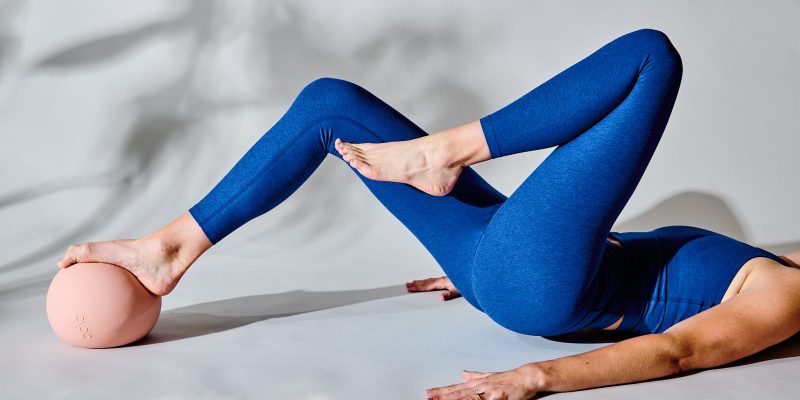
One of the most effective ways to accomplish this is through a 90/90 supine hip lift. Lie flat on your back with your feet flat against a wall, knees and hips bent to ninety degrees. Without pushing your feet into the wall, gently drag your heels downward toward the floor. This subtle action activates the hamstrings as knee flexors and rotates your pelvis backward into a neutral position, instantly taking the stretch off the back of the legs.
From this position, take a slow, complete exhale through your mouth to drop your ribcage down and engage your deep abdominal wall. By holding this alignment for four to five deep breaths, you teach your nervous system that the pelvis can remain stable without relying on high resting tone.
Build Eccentric Strength
If your hamstrings actually do lack functional length, static stretching is the least efficient way to change tissue architecture. A far superior tool is eccentric training, which involves loading the muscle as it lengthens under control.
Exercises like the Romanian deadlift and seated leg curls with a slow lowering phase trigger a cellular adaptation known as sarcomerogenesis, the addition of contractile units in series along the muscle fiber. This process physically lengthens the muscle over time while simultaneously training the brain to feel safe and strong at end ranges of motion.
When performing a Romanian deadlift, focus on pushing your hips backward as if trying to touch a wall behind you with your tailbone, maintaining a soft bend in the knees and a flat spine. Lower the weight slowly over three to four seconds, pause momentarily when you feel a comfortable stretch through the muscle belly, and return to standing by driving your hips forward.
Wake Up the Glutes and Abdominals
To relieve your hamstrings of their exhausting secondary duties, you must restore the capacity of your primary movers.
Integrate targeted glute work, such as single-leg glute bridges and hip thrusts, into your routine prior to lifting, running, or extended periods of walking. During these movements, consciously focus on initiating the extension from your hip rather than arching your lower back or pulling with your knees.
Combine this with anterior core exercises like deadbugs or farmer’s carries that teach your abdominal wall to resist being pulled into an excessive anterior pelvic tilt. When the core stabilizes the front and the glutes power the back, the hamstrings are finally allowed to stand down.
Incorporate Nerve Flossing
If adverse neural tension is the root cause of your stiffness, replace aggressive stretching with sciatic nerve glides, often referred to as nerve flossing.
Sit upright on the edge of a sturdy chair with your hands behind your back. Slump your shoulders and drop your chin toward your chest. Slowly straighten one knee while simultaneously pointing your toes away from you, keeping tension off the nerve at the foot while taking up slack at the knee. Then, as you bend the knee back underneath you, pull your toes toward your shin.
By alternating these positions smoothly for ten to twelve repetitions, you gently slide the sciatic nerve back and forth through its soft-tissue pathways without ever placing it under maximum tension. Over several weeks, this restores normal nerve excursion and eliminates the protective guarding around the joint.
Moving Past the Stretch
The persistent tightness in your hamstrings is not an anatomical defect, nor is it a personal failing in your stretching routine. It is a calculated, protective response from a nervous system trying to manage mechanical strain, compensate for inactive neighbors, or safeguard an irritated nerve.
Stop viewing your hamstrings as stubborn ropes that need to be pulled apart. Focus instead on restoring pelvic alignment, strengthening your glutes, stabilizing your core, and loading the tissue through full, active ranges of motion. When you give your body the stability and alignment it needs, the chronic tightness disappears on its own.
What is your reaction?
Excited
0
Happy
0
In Love
0
Not Sure
0
Silly
0